
Hadrian's Wall: No One Stopped Us
Romans built this wall to mark the edge of the known world. Standing on it in beskar, that assessment still holds. Ji'ana Fenix and HK7335. Nobody was manning the wall.
FIELD NOTES
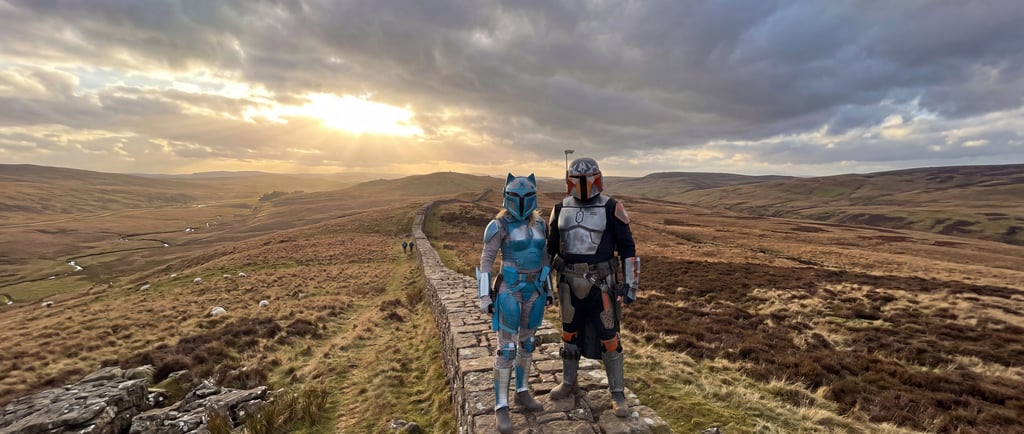
Armor Field Note: Hadrian's Wall, Northumberland, England
The Romans knew something about holding a line.
Hadrian's Wall cuts across northern England like a scar in the landscape, seventy-three miles of engineered stubbornness that held barbarians at bay for three centuries. Standing here in full beskar'gam, I can appreciate their commitment to the principle that sometimes the best defense is a really impressive wall.
The hikers are fascinating. They trek for miles across windswept moorland to see stones, carrying packs that would make a decent loadout if filled with anything useful instead of sandwiches and rain gear. Most barely glance at my armor—apparently assuming I'm part of some historical reenactment. One elderly woman asked if I was "with the Romans today" and seemed genuinely disappointed when I explained the timeline discrepancy.
The wall itself commands respect. Roman engineering at its most pragmatic, built to last and built to intimidate. Every stone placed with military precision, watchtowers positioned for maximum coverage, gates designed to funnel enemies into kill zones. These weren't architects playing at war—they were soldiers who understood that deterrence requires visible strength.
A ranger approached me near Housesteads Fort, concerned about my "replica armor" potentially damaging the ancient stones. I assured him beskar doesn't scratch easily. He seemed more worried about the stones scratching me, which suggests an admirable dedication to preservation but a fundamental misunderstanding of Mandalorian metallurgy.
The wind here never stops. It cuts through the valleys with the persistence of an empire, carrying the weight of centuries. Roman sentries stood these same watches, scanning the northern horizon for threats that might never come but probably would. I understand the vigil.
Weather changes quickly on the wall, sun giving way to driving rain without warning. The Romans built for this climate, designed for soldiers who had to function regardless of conditions.
Apparently guarding the frontier hasn't gotten any more comfortable since 122 AD.
© Mando Armory 2026. All rights reserved.