
Stonehenge: No One Stopped Us
The stones have been there 5,000 years. They've seen some things. This was probably a highlight. Ji'ana Fenix and HK7335 at Stonehenge. No one stopped them.
FIELD NOTES
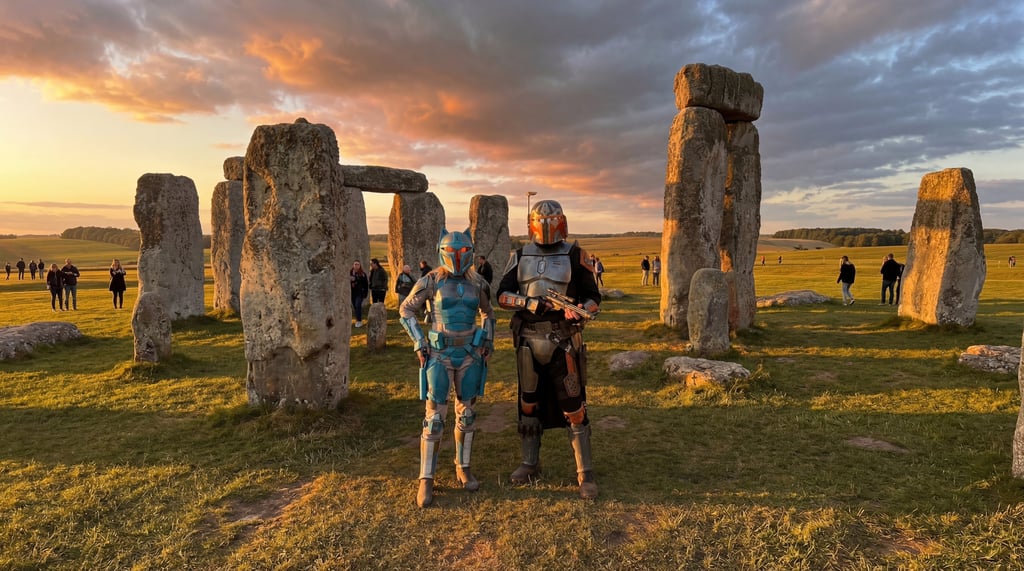
Armor Field Note: Stonehenge, Wiltshire, England
Ancient stone circles still draw crowds after five millennia, which suggests humans have always needed something to worship.
The rope barriers here remind me of containment fields, though considerably less sophisticated. English Heritage wardens patrol with the dedication of honor guards protecting a temple, which isn't entirely inaccurate. They maintain careful distance between visitors and the megaliths with practiced efficiency. The stones themselves command respect—each one weighs more than a full squadron's worth of gear, arranged with precision that would impress any Mandalorian architect.
Tourists shuffle along the designated path in reverent whispers, cameras raised like offerings. A few children attempt to duck under the ropes before parents intercept them with mortified apologies to nearby wardens. The security personnel maintain professional composure despite my presence, though I notice subtle double-takes at my T-visor's reflection in the ancient bluestone. One guard inquires politely about "special permission" for my equipment. I show my standard visitor ticket.
The monument's purpose remains debated among archaeologists—astronomical calculator, healing temple, burial ground. Standing here in full beskar, I appreciate the builders' commitment to permanence. They erected something designed to outlast civilizations, and succeeded. The craftsmen who shaped these sarsen stones understood that some things are worth building to last forever, regardless of whether future generations remember why.
HK7335 remains uncharacteristically quiet during our circuit, his photoreceptors tracking the stone alignments with unusual focus. Even droids recognize sacred geometry when they encounter it.
The gift shop sells miniature stone circles made in China, which somehow seems appropriate for a monument that's survived this long by adapting to each era's interpretation of its significance.
Apparently the ancients solved the eternal problem of keeping tourists at respectful distances without using a single rope barrier.
© Mando Armory 2026. All rights reserved.